- Why critical production equipment fails earlier than engineering specifications predict
- Reconditioning economics that shift the replacement decision calculus
- Predictive maintenance strategies that catch degradation before precision suffers
- Determining the optimal intervention point for aging production systems
Why critical production equipment fails earlier than engineering specifications predict
Wafer handling robots rated for 10-year operational lifespans often exhibit precision drift within 18 months of continuous production use. The gap between laboratory-validated durability and field performance stems from factors manufacturers cannot fully model: particulate contamination in cleanroom environments varies by facility airflow design, thermal expansion cycles from process tool proximity differ across fab layouts, and mechanical wear accelerates under the repetitive motion profiles specific to each production recipe.
Engineering analysis of failure modes reveals that wear components—bearings subjected to millions of articulation cycles, encoder assemblies exposed to micro-vibrations, belt tensioning systems operating in temperature-variable zones—degrade along trajectories influenced by operational intensity rather than calendar age. A peer-reviewed analysis published in Procedia Computer Science (2025) demonstrates that accurate machine downtime prediction remains challenging due to high variability and complex data patterns inherent to semiconductor manufacturing. The most frequently overlooked factor in equipment longevity is the cumulative effect of deferred minor interventions—a bearing developing slight axial play, an encoder losing calibration incrementally, a drive belt stretching beyond optimal tension—each individually below alarm thresholds yet collectively pushing the system toward out-of-specification operation.
Reactive maintenance approaches wait for functional failure, by which point precision has already degraded sufficiently to impact yield. The critical threshold for refurbishment is before catastrophic breakdown, when systematic component replacement can restore original performance. High-volume semiconductor manufacturing operates under stringent availability requirements, making the window between detectable degradation and production-impacting failure narrow. Proactive intervention strategies transform this narrow window into a controllable maintenance opportunity rather than an emergency repair crisis.
Reconditioning economics that shift the replacement decision calculus
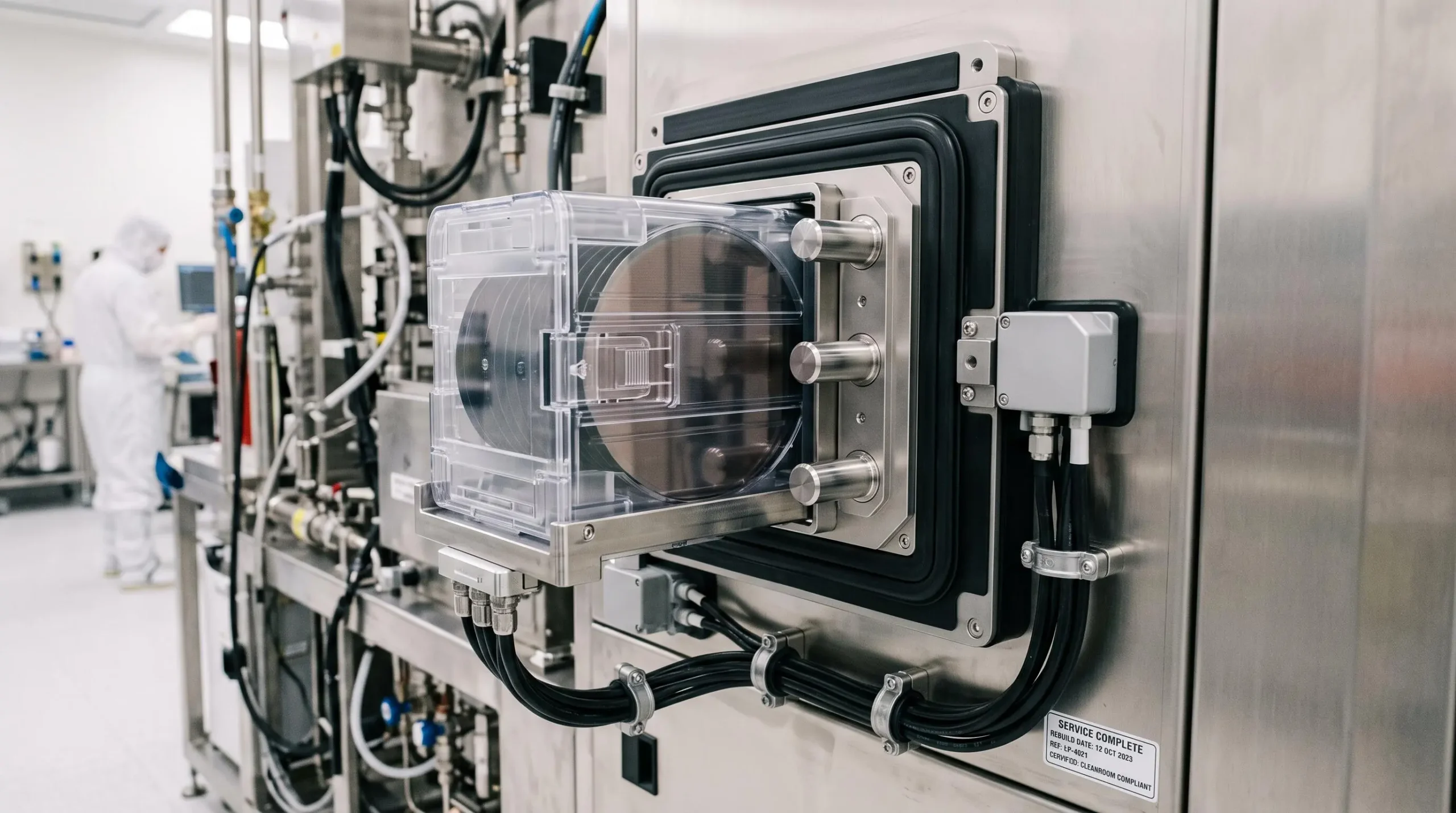
Full equipment replacement in semiconductor fabrication carries costs extending well beyond the purchase invoice. Installation demands cleanroom reconfiguration, process re-qualification consumes weeks of production capacity, and operator retraining introduces yield variability during the transition period.
The quarterly World Fab Forecast published by SEMI confirms global semiconductor manufacturing capacity growth of 6% in 2024 and 7% in 2025. This capital investment cycle places pressure on maintenance budgets, making the economic case for extending existing asset life increasingly compelling. Procurement lead times for new semiconductor equipment typically span 12 to 16 weeks from order placement through delivery and installation—a timeline incompatible with unplanned equipment failures in production environments targeting uptime above 98%.
| Criterion | Full Replacement | Certified Refurbishment | Impact Assessment |
|---|---|---|---|
| Initial Capital Cost | 380000–1200000 £ | Professional refurbishment typically represents a fraction of capital expenditure | Significant capex preservation |
| Installation Downtime | 12–16 weeks (procurement + installation + qualification) | 3 weeks complete rebuild or under 7 days exchange | 75–85% downtime reduction |
| Precision Restoration | New equipment to OEM specification | Restored to OEM tolerance with certified parts | Equivalent precision capability |
| Parts Availability Risk | Dependent on OEM production schedule | Specialists maintain legacy parts inventory | Lower obsolescence exposure |
| Warranty Coverage | 12–24 months OEM warranty | 12 months post-installation warranty | Comparable protection period |
The strategic alternative emerging across high-precision manufacturing involves certified reconditioning programmes that systematically replace degraded components whilst preserving the functional equipment platform. The latest SEMI World Fab Forecast (2025) shows Foundry capacity projected to increase 10.9% year-over-year, underlining how capital constraints make asset optimisation valuable. Rather than discarding mechanically sound frames, drive systems, and control architectures, refurbishment targets the actual failure points: bearing assemblies, encoder systems, belt drives, and articulation joints.
Industry refurbishment specialists report that properly executed reconditioning with OEM-certified parts and ISO9001 quality processes can restore equipment performance to meet original tolerance specifications. Strategic lifecycle management requires access to semi-conductor production machine reconditioning department capabilities that combine OEM-grade component sourcing with precision testing protocols—24-hour repeatability validation cycles confirm restored performance before equipment returns to production environments. Exchange programmes delivering refurbished systems in under 7 days eliminate the prolonged downtime that makes emergency replacements so economically damaging, whilst complete refurbishment within 3 weeks remains substantially faster than new equipment procurement cycles.
Legacy EFEM robotics: when OEM discontinuation forces strategic choice
Scenario: A mid-sized semiconductor fabrication facility operating three legacy wafer handling robots from a discontinued product line faced mounting precision degradation causing yield issues. The OEM declared the equipment obsolete and quoted £380,000 per unit replacement with 16-week lead times. Budget constraints and production schedules made simultaneous replacement infeasible.
Constraints: The facility could not tolerate 16-week downtime per tool, capital budget proved insufficient for three simultaneous replacements, yield losses mounted as precision drifted beyond tolerance, and OEM parts availability declined rapidly as the manufacturer shifted production focus to newer models.
Solution pathway: A third-party semiconductor equipment specialist performed comprehensive refurbishment, replacing all wear components including bearings, belts, and encoder assemblies. Motion control systems underwent complete recalibration, followed by 24-hour repeatability testing cycles to validate compliance with original OEM specifications.
Outcome: Equipment precision restored to original tolerance bands within 3 weeks per unit. The facility staggered refurbishment across production schedules, maintaining output throughout the intervention period. Twelve-month warranty coverage provided comparable protection to new equipment guarantees, whilst the total investment remained a fraction of the OEM replacement quote. The reconditioning eliminated forced obsolescence and preserved capital budget for other facility improvements.
The economic transformation occurs when maintenance directors recognise refurbishment not as a compromise solution but as a strategic capability. Facilities that build relationships with certified reconditioning specialists gain optionality unavailable to those locked into OEM-only service channels—particularly valuable when managing legacy equipment beyond manufacturer support lifecycles.
Predictive maintenance strategies that catch degradation before precision suffers
Monitoring protocols specific to semiconductor robotics identify wear patterns before they manifest as positional errors. Vibration signature analysis detects bearing degradation weeks before functional failure, encoder accuracy validation reveals calibration drift in sub-micron increments, and door cycle counting on loadports triggers intervention at 80% of rated component lifecycle rather than waiting for mechanical breakdown.
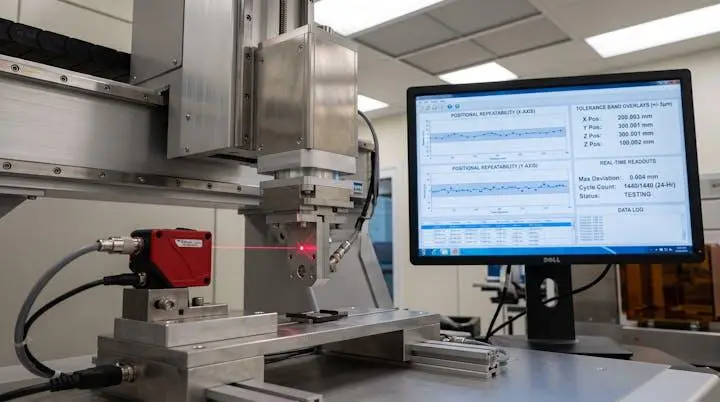
Conducting 24-hour repeatability testing validates equipment precision under continuous operational stress rather than snapshot measurements that miss intermittent drift patterns. High-precision wafer handling equipment operates within tight positional tolerance bands specified by manufacturers—deviations beyond ±0.1mm compromise transfer reliability and risk wafer damage. Scheduled component replacement based on manufacturer cycle ratings prevents cascade failures when degraded bearings induce vibration across the kinematic chain, accelerating wear in adjacent assemblies. Reconditioning specialists employ extended testing cycles to validate performance after component replacement, ensuring restored systems meet acceptance criteria before returning to production.
- Weekly vibration signature trending on robot arm bearings and drive motors to establish degradation baselines
- Monthly positional repeatability spot checks at critical transfer points using calibrated measurement fixtures
- Quarterly encoder accuracy validation against calibrated reference positions to detect drift patterns
- Bi-annual comprehensive 24-hour repeatability testing cycles under production-equivalent load conditions
- Continuous door cycle count monitoring on loadports with intervention threshold at 80% of rated lifecycle
The transition from reactive to condition-based servicing requires investment in monitoring infrastructure and expertise to interpret trending data. Facilities that implement systematic tracking reduce unplanned stoppages by identifying intervention windows during scheduled maintenance periods rather than responding to emergency failures during production runs. Precision drift alerts configured within ±0.05mm of specification limits provide sufficient lead time to schedule component replacement without production disruption.
Maintenance directors report that the economic return on predictive programmes compounds over equipment lifecycles—early intervention prevents the secondary damage that occurs when degraded components remain in service. A worn bearing left unaddressed doesn’t simply fail in isolation; it induces vibration that accelerates encoder wear, misaligns kinematic couplings, and stresses drive motors beyond design parameters. The principles underlying proactive monitoring share conceptual foundations across industrial sectors, with parallel efficiency strategies documented in renewable energy contexts such as practical tips for solar-farm efficiency demonstrating how systematic performance tracking optimises asset utilisation across technology domains. Predictive protocols catch single-component degradation before it cascades into multi-system failures requiring extensive refurbishment or premature replacement.
Determining the optimal intervention point for aging production systems
Equipment age measured in calendar years provides insufficient guidance for refurbishment decisions. A five-year-old robot operating in a low-volume R&D fab may retain superior precision to a two-year-old system subjected to continuous high-cycle production loads. The multi-factor assessment framework examines remaining precision capability through repeatability testing, parts availability through specialist supplier channels, production criticality based on line dependencies, and technological obsolescence risk from process evolution.
Precision capability assessment begins with quantitative measurement against OEM specifications. Equipment drifting toward tolerance limits but still within specification represents an ideal refurbishment candidate—intervention restores margin before out-of-spec operation impacts yield. Parts availability investigation extends beyond OEM channels to specialist reconditioning providers who maintain legacy component inventories and reverse-engineering capabilities. Production criticality analysis weighs single-point-of-failure risks against redundancy options: critical-path equipment with no backup capacity justifies earlier intervention than redundant systems where failure can be absorbed through production rebalancing.
Technological obsolescence presents the most nuanced criterion. Equipment that remains functionally adequate for current process requirements but faces obsolescence from next-generation technology transitions may warrant deferring major refurbishment investment. Conversely, legacy systems supporting stable mature products with multi-year production horizons justify comprehensive reconditioning to maximise remaining service life. The decision matrix integrates these factors into weighted scoring rather than relying on arbitrary age thresholds or reactive failure response.
Can refurbished equipment truly match OEM precision specifications for semiconductor applications?
When performed by ISO9001-certified specialists using OEM-grade replacement parts, refurbishment can restore equipment to original tolerance specifications. The key validation is 24-hour continuous repeatability testing against manufacturer acceptance criteria—properly refurbished equipment must pass the same testing protocols as new systems. High-precision wafer handling equipment operates within tight positional tolerance bands, and certified reconditioning targets restoring these performance parameters through systematic component replacement rather than superficial repair.
How does refurbishment warranty compare to new equipment coverage?
Reputable reconditioning specialists provide 12-month post-installation warranties covering both parts and labour—comparable to many OEM warranty structures. The warranty should explicitly cover precision performance to specification, not merely functional operation. This performance guarantee reflects the specialist’s confidence in component quality and testing validation, providing equivalent protection to new equipment whilst delivering substantially faster deployment timelines.
What happens when OEM parts are no longer available for obsolete equipment?
Specialist refurbishment providers often maintain legacy parts inventories and engineering capabilities to fabricate replacement components for discontinued models. This extends viable service life well beyond OEM support lifecycles, though economic viability should be assessed against replacement cost. Third-party specialists can support obsolete equipment no longer serviced by original manufacturers, providing strategic optionality when managing aging production assets.
At what point does refurbishment become uneconomical compared to replacement?
The economic threshold typically occurs when refurbishment costs approach significant fractions of replacement cost, parts availability becomes severely constrained, or technological obsolescence limits production capability. A multi-factor assessment considering downtime impact, precision requirements, and remaining asset life provides better guidance than cost alone. Equipment supporting stable mature products with multi-year production horizons justifies comprehensive reconditioning, whilst systems facing near-term process technology transitions may warrant replacement timing aligned with production transitions.
How quickly can refurbished equipment be deployed compared to new purchases?
Exchange programmes can deliver refurbished equipment in under 7 days, whilst complete rebuild refurbishment typically requires 3 weeks—substantially faster than 12 to 16-week lead times common for new semiconductor equipment procurement and installation. This timeline advantage proves critical when managing unplanned failures in production environments where extended downtime directly impacts revenue and customer delivery commitments. The compressed deployment cycle transforms emergency situations into manageable maintenance interventions.
Facilities establishing proactive assessment rhythms—annual precision audits, quarterly parts availability reviews, bi-annual technological roadmap alignment—gain lead time to execute planned refurbishment during scheduled maintenance rather than emergency response. Multi-factor decision criteria form part of the foundation of industry excellence that distinguishes high-performing manufacturing operations. Building relationships with certified reconditioning specialists before equipment reaches critical degradation provides strategic optionality unavailable to facilities operating purely on OEM-dependent service models.